What to Expect in the Future of Human-Machine Interactions?
Exploring the future of AI ethics through the lens of Moore's Law, the Singularity, and the fundamental challenges we face in defining moral status for intelligent machines.
This article is the final part of a series written during a seminar course on science and ethics. The series explores the relations between robots, intelligent systems and humans.
Read the previous part: Popular Culture and AI
The Ethical Challenges Ahead
No matter the form, Artificial Intelligence comes with great challenges regarding basic ethical questions. We saw that those difficulties come from the way we manage to actually define what is an intelligent machine so we can better interact with them. Rapid advances in computing completely turned upside down the efficiency of machines and we have seen an evolution in the mentality about AI through culture and art. Machines that can both act for good or evil.
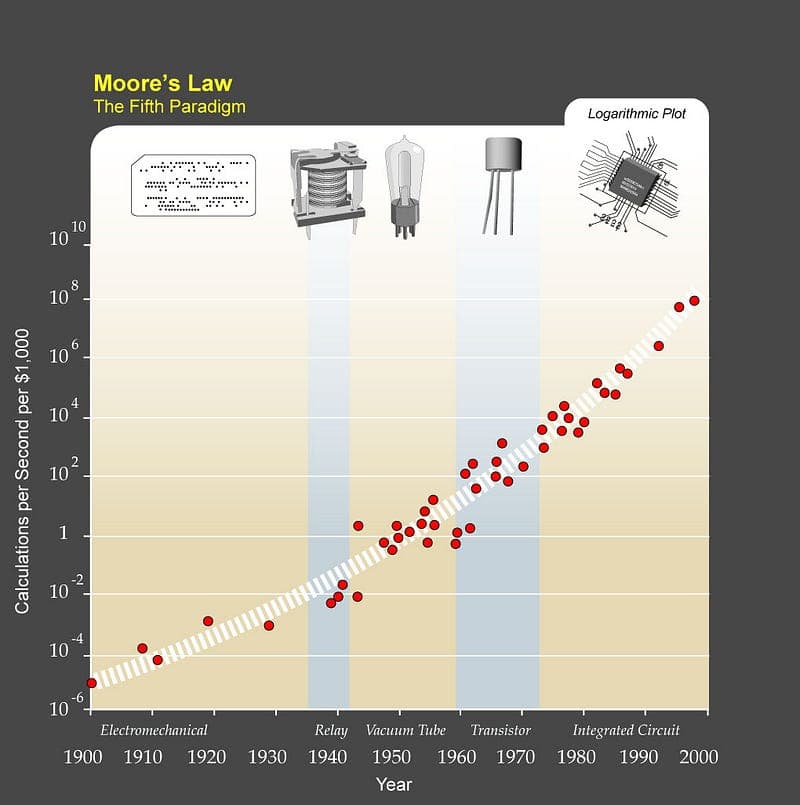
 Moore's Law: The exponential growth of computing power
The Singularity
Inspired by Moore's law that theorizes and predicts the exponential growth of the capacity in integrated circuits, Ray Kurzweil explains in The Singularity is Near that the exponential growth of progress should bring a new paradigm that defies human understanding. He calls it the Singularity.
One could imagine that such event would unravel any concept we had so far about ethics in AI. Indeed, how could we define a proper moral status for those systems when we can't even understand them?
The biggest error that could arise is the will to impose the same standardized human ethics to the current and the next generation of robots, as it would imply that we are the same species when we should actually consider any artificial intelligence revolution as the birth of a new species.
An Alternative View
Obviously, you could criticize such point of view and see the growth more like a logistic function. In that case, it will be convenient to have ethical rules for when the growth will stabilize. Given the time, roboticists will be able to have a better understanding of AI and its implications, allowing to have a common ground on basic ethical questions.
Conclusion
Throughout this series, we've explored:
- The nature of AI - Understanding that an AI is fundamentally a decision-support system based on predefined intelligence
- The definition of robots - Examining embodiment, autonomous behavior and the various perspectives from mere machines to a new species
- Cultural perspectives - How popular culture shapes our understanding of AI ethics through works like Asimov's laws and HAL 9000
- Future considerations - The challenges that exponential technological growth poses for ethical frameworks
The only biggest error that could arise is the will to impose the same standardized human ethics to the current and the next generation of robots, as it would imply that we are the same species when we should actually consider any artificial intelligence revolution as the birth of a new species.
This concludes the Ethics in AI series. Thank you for reading!
Start from the beginning: Part 1: Introduction to Ethics in AI